
A site manager’s daily log is a dated record of who was on site, what work got done, what was delivered, what the weather did and what went wrong, written on the same day. The template below is free to print or copy into Word or Excel. It covers everything a daily record sheet needs. The catch with paper is that the sheet you need most is usually the one that went missing, so we’ll also cover how to keep the record reliable.
What a daily site log should include
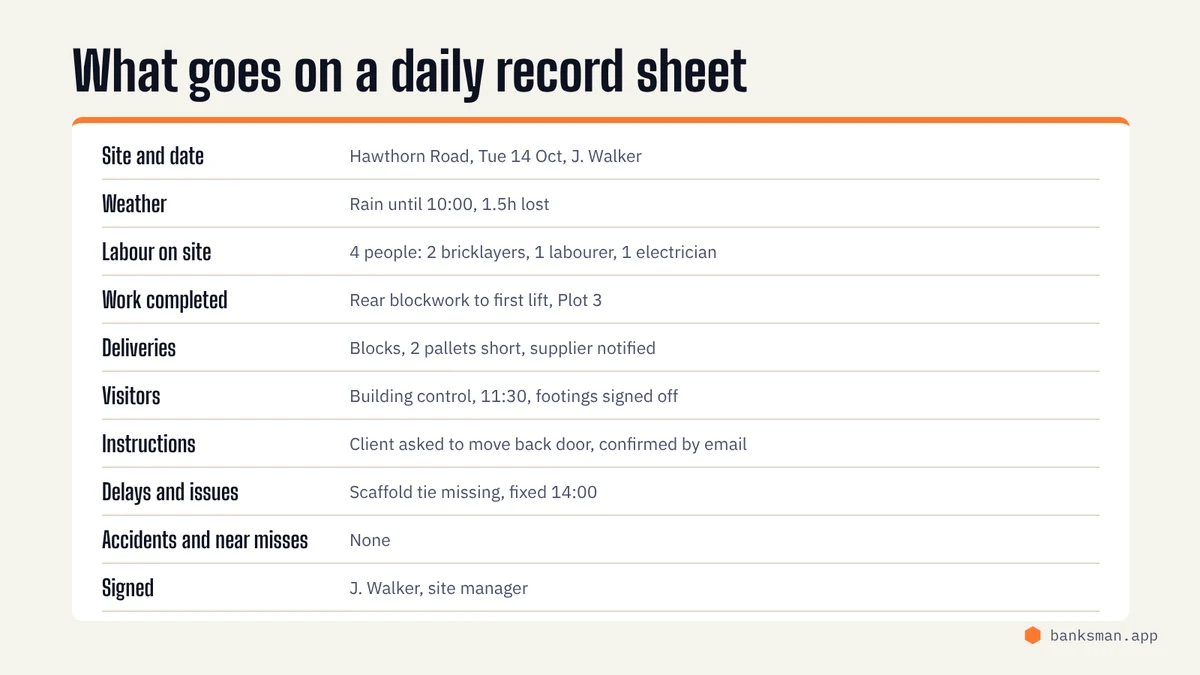
A good daily log is short enough to fill in every day and detailed enough to settle an argument six months later. These are the sections that matter:
| Section | What to write |
|---|---|
| Site and date | Site name or address, date, and who filled the sheet in |
| Weather | Conditions in the morning and afternoon, plus any time lost to rain, wind or cold |
| Labour on site | Each person’s name, trade or company, start and finish times, and whether it’s daywork or price work |
| Work completed | What got done and where: plot, elevation, room or floor |
| Materials and deliveries | What arrived, from which supplier, and anything short, damaged or late |
| Plant and equipment | What was on site, what was hired in or off hired, and any breakdowns |
| Visitors and inspections | Building control, the client, the architect, the health and safety adviser and so on |
| Instructions and variations | Any change requested on site, who asked for it, and whether it’s been confirmed in writing |
| Delays and issues | What stopped work, how long for, and why |
| Accidents and near misses | Anything reported, and where the full report is kept |
| Sign off | Name and signature of the site manager |
Download the free template
Download the daily site log template (PDF). It’s a one-page sheet with every section above. Print a pad of them for the van.
How to fill it in so it actually holds up
A daily log is only as useful as the habits behind it. A few rules make the difference:
- Write it on the day. A sheet filled in on Friday for the whole week is a memory test, not a record.
- Be specific. “Blockwork” tells nobody anything. “Rear elevation blockwork to first lift, Plot 3” does.
- Write down numbers. Hours, quantities, delivery sizes, time lost to weather. Numbers are what end disputes.
- Record instructions as they happen. If the client asks for a door to move, write down who asked, when and what was agreed. Then confirm it in writing.
- Take photos and say where they are. A line saying “photos of drainage before backfill taken 07:50” is worth more than you’d think.
- Sign it. A signed sheet carries more weight than an unsigned one.
Why paper sheets get lost
Paper daily logs fail for practical reasons, not because anyone is careless.
They live in the van. The pad sits on the dashboard, gets rained on, ends up under a bag of fixings and goes in the skip during a clear out.
There’s only one copy. If the sheet is lost, the record is gone. Nobody in the office saw it.
They don’t get typed up. The plan is always to transfer them to a spreadsheet. By the end of the month there are twenty sheets in a pile and nobody has time.
You can’t search them. When a client asks when the kitchen units arrived, someone has to flick through every sheet from the spring.
They’re not tied to anything. A photo on someone’s phone and a line on a paper sheet are two separate things. Proving they belong together is harder than it should be.
When to move the daily log onto a phone
Paper works fine for a single small job with one person keeping the record. The cracks show when:
- You’re running more than one site at a time
- More than one person needs to see the record, such as the office or a contracts manager
- Hours on the log feed into wages, invoices or CIS paperwork
- You’ve had a dispute where the log was missing or vague
At that point it’s worth recording the day where the work happens, which is what a construction site diary app is for: on site, on a phone, with photos attached to the job they belong to, and visible to the office the same day.
Banksman records tasks, hours, materials and photos on site every day, so the office sees the daily record without waiting for a paper sheet. Try the live demo, no card required.
FAQ
Is a site diary a legal requirement in the UK?
There's no general law that says every job must keep a daily log. Many contracts do require site records, though. A dated daily log is often the best evidence you'll have in a dispute about delays, variations or hours worked.
How long should I keep daily site records?
At least as long as someone could bring a claim about the work. In England and Wales that's normally six years for a simple contract and twelve years for a contract signed as a deed. Check with your solicitor or insurer if you're unsure.
Should I use Word, Excel or paper for my daily log?
Any of them is better than nothing. Paper is quickest on site. Excel is easiest to total up. Both rely on someone keeping the records together. An app avoids the typing up and keeps the record in one place.
Who should fill in the daily log?
Usually the site manager or foreman. Workers can log their own hours and tasks, as long as someone else reviews them before they reach an invoice.