
To manage site inductions and RAMS without drowning in paper, keep one current version of each document per site, make sure everyone who starts on site is inducted and has seen the RAMS for their work, and record that sign off in a way the office can check without driving to site. The paperwork isn’t optional, but the piles of it are.
What the law actually requires
It helps to separate what’s a legal duty from what’s become standard practice.
Risk assessments. Every employer has to assess the risks of the work under the Management of Health and Safety at Work Regulations 1999. If you employ five or more people, you must record the significant findings in writing.
Method statements. These aren’t a standalone legal requirement, but they’re a standard way of showing a safe system of work, and most principal contractors won’t let you start without one. In practice, if you’re working for someone else, you’ll need RAMS.
Site inductions. Under the Construction (Design and Management) Regulations 2015, the principal contractor must make sure a suitable site induction is provided. Contractors must make sure their own workers have one too, where the principal contractor hasn’t already provided it. The induction has to be specific to the site, not a generic company talk.
This is a summary, not a substitute for HSE guidance. If you’re unsure about your duties on a particular job, check the HSE website or speak to your health and safety adviser.
Why RAMS and inductions turn into a paper mountain
Every job needs its own version. RAMS have to fit the site and the task. A generic set copied from the last job doesn’t do the job and won’t satisfy a decent principal contractor.
They change. New hazards, new methods, a different crane or a change in sequence all mean the document should be reviewed. The old copy rarely gets thrown away.
Proving someone has read them is hard. A signature sheet in a folder in the cabin is fine until it gets wet, lost or filled in for someone who wasn’t there.
New starters turn up all the time. Subbies, labourers and delivery drivers arrive at short notice, and each one needs inducting before they start.
The office can’t see what’s happening. Head office only finds out an induction was missed when something goes wrong.
What a good induction covers
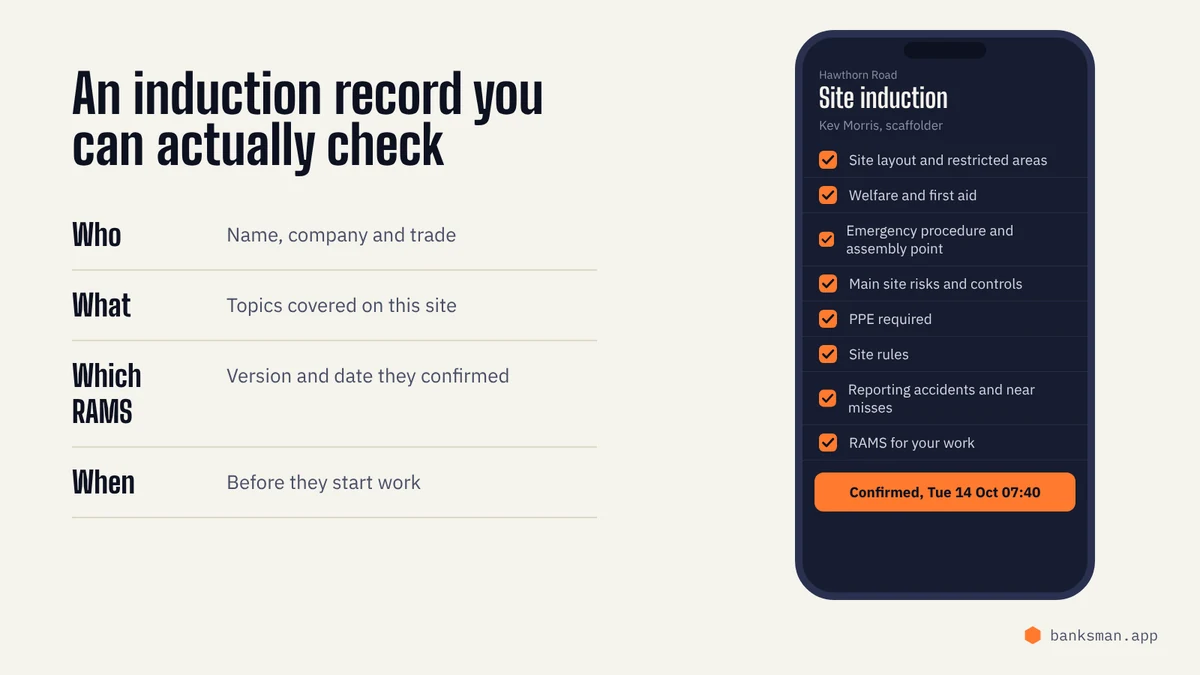
A site induction should be short, specific and recorded. It typically covers:
- Site layout, access routes and restricted areas
- Welfare facilities and first aid
- Emergency procedures, assembly point and fire points
- The main risks on this site and the controls in place
- PPE required
- Site rules, including working hours, smoking and phones
- Who to report to, and how to report accidents and near misses
- The RAMS relevant to the person’s work
How to keep RAMS and inductions under control
- Keep one current version per site. Store RAMS against the job they belong to, with a clear revision and date. Remove old versions from circulation, don’t just pile new ones on top. The same goes for drawing revisions.
- Brief, don’t just hand over. A worker signing to say they’ve read a 30 page document isn’t the same as understanding it. Talk through the key risks.
- Record sign off properly. Name, company, date, and which version they confirmed. If the RAMS change, get the relevant people to sign the new version.
- Induct before work starts, not after. Build it into the first morning so nobody picks up a tool beforehand.
- Review after changes. If the method, sequence or site conditions change, the RAMS need reviewing. Note what changed and who’s been briefed.
- Make it visible to the office. Whoever is responsible for health and safety should be able to see who’s been inducted on each site without ringing round.
Banksman keeps site information, tasks and messages in one place for each job, so the office can see what’s happening on site without the paper chase. Try the live demo, no card required.
FAQ
Do I need RAMS for a small domestic job?
You need a risk assessment for any work, and must record it in writing if you employ five or more people. A method statement isn't a legal requirement in itself, but writing one for higher risk tasks is good practice, and it's what most clients and main contractors expect.
Is a digital site induction valid?
CDM 2015 requires a suitable, site specific induction. It doesn't say it has to be on paper. What matters is that the content fits the site and that you can show who received it and when. Many firms deliver part of it digitally and the rest as a walk round on site.
How often should RAMS be reviewed?
Whenever there's reason to think they're no longer valid: a change in method, conditions, equipment or people, or after an accident or near miss.
Who is responsible for inducting subcontractors?
On jobs with more than one contractor, the principal contractor must make sure a suitable induction is provided. Each contractor must also make sure its own workers have been inducted.