
Most subcontractor payment disputes don’t start with bad faith. They start with missing proof. One side says the gang was on site for three days, the other says two, and nobody wrote it down at the time. The way to avoid them is simple to describe and harder to stick to: record who was on site and what they did on the day, get daywork signed off before it’s invoiced, and follow the payment notice rules in the Construction Act.
This guide covers both sides: main contractors paying subbies, and subbies trying to get paid.
Where payment disputes actually come from
Hours nobody can prove. Daywork written on the back of a delivery note, or added up from memory at the end of the month, is easy to challenge.
Extras agreed by word of mouth. “While you’re there, can you sort the downpipe?” turns into an invoice line the main contractor doesn’t remember agreeing to.
Work signed off late or never. If nobody confirmed the work was complete at the time, the question of quality turns up when the money is due.
Missed payment notices. Under the Construction Act, the payer has to issue notices on time. When they don’t, disputes get decided on the paperwork, not on the work.
CIS confusion. Deductions taken from the wrong amount, or at the wrong rate, leave the subbie short and arguing about money that’s actually with HMRC.
What counts as proof of work
The best proof is created at the time, by the people involved, and tied to the job. That means:
-
Who was on site. Names, trades, and start and finish times for each day.
-
What they did. Specific enough to identify: “first fix electrics, Plot 4, ground floor”, not “electrics”.
-
Photos at the right moments. Before work is covered up, at completion, and of anything that was found wrong when they arrived.
-
Daywork sheets signed off. Confirmed by someone from the main contractor’s side, ideally on the day, and kept separate from price work.
-
Variations in writing. Even a short message confirming who asked for the extra, what it was and how it will be paid.
How to sign off a daywork sheet properly
A daywork sheet is only useful if both sides agree it’s accurate. Every sheet should show:
-
The date, the site and the specific location of the work
-
Each worker’s name, trade and hours
-
Plant and materials used, kept separate from labour
-
A description of the work and why it was daywork rather than priced
-
The name and signature of the person approving it, and the date they approved it
Get the sheet signed while the work is still fresh. A sheet presented three weeks later is far easier to dispute than one signed on the day.
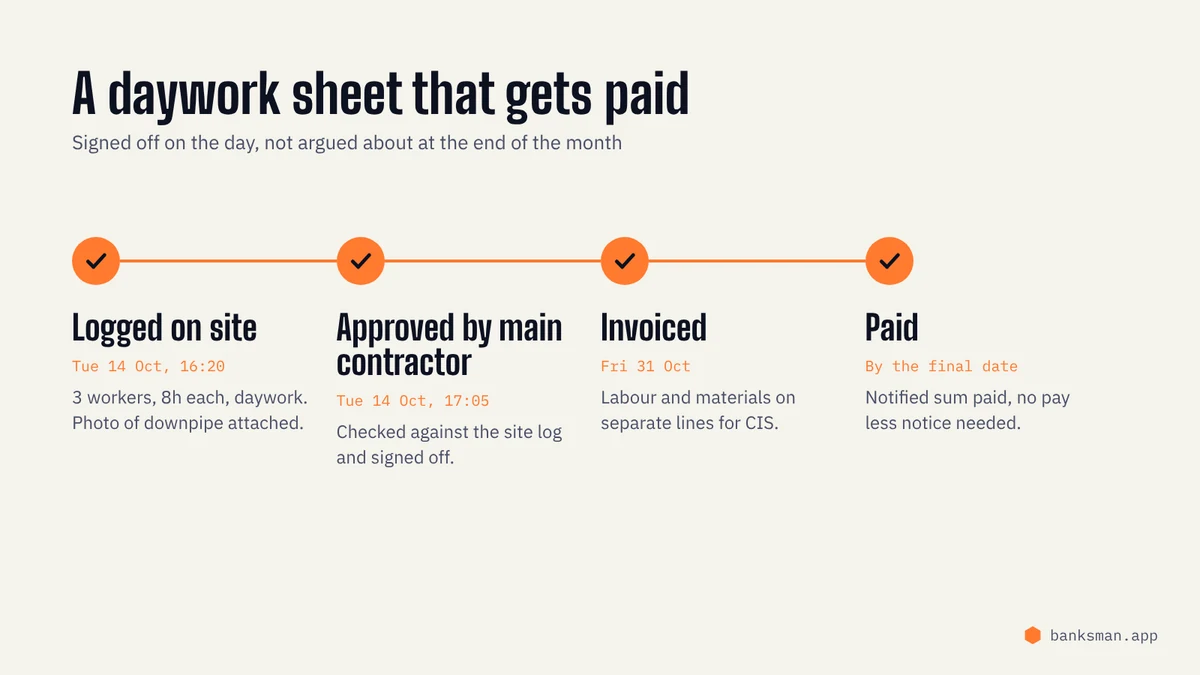
Payment notices: the rules that settle most arguments
If your contract is a construction contract in England, Wales or Scotland, the Housing Grants, Construction and Regeneration Act 1996 (the Construction Act) applies. In short:
-
Payment notice. The payer must issue a payment notice within five days of the due date, saying what they think is owed and how they worked it out.
-
Pay less notice. If the payer wants to pay less than the notified sum, they must issue a pay less notice before the final date for payment, setting out the new amount and the reasons. Under the statutory Scheme, that’s at least seven days before the final date.
-
No notice, no deduction. Without a valid pay less notice, the notified sum generally has to be paid, even if the work is disputed.
-
Right to suspend. If the notified sum isn’t paid by the final date, the unpaid party can suspend work after giving seven days’ written notice.
-
Adjudication. Either party can refer a dispute to adjudication at any time.
Your contract may set its own dates. Where it doesn’t, or where it doesn’t comply with the Act, the Scheme for Construction Contracts fills the gaps. This is general information, not legal advice. Check your own contract, and speak to a solicitor if a dispute is serious.
CIS and daywork: get the split right
Under the Construction Industry Scheme, contractors deduct tax from the labour part of a subcontractor’s payment. The rates are 20% for registered subcontractors, 30% for unregistered ones, and nothing for those with gross payment status.
Deductions apply to labour, not materials. That’s why a daywork sheet that keeps labour, plant and materials on separate lines saves arguments later. If materials get lumped in with labour, the deduction comes out too high and the subbie is left short until they reclaim it.
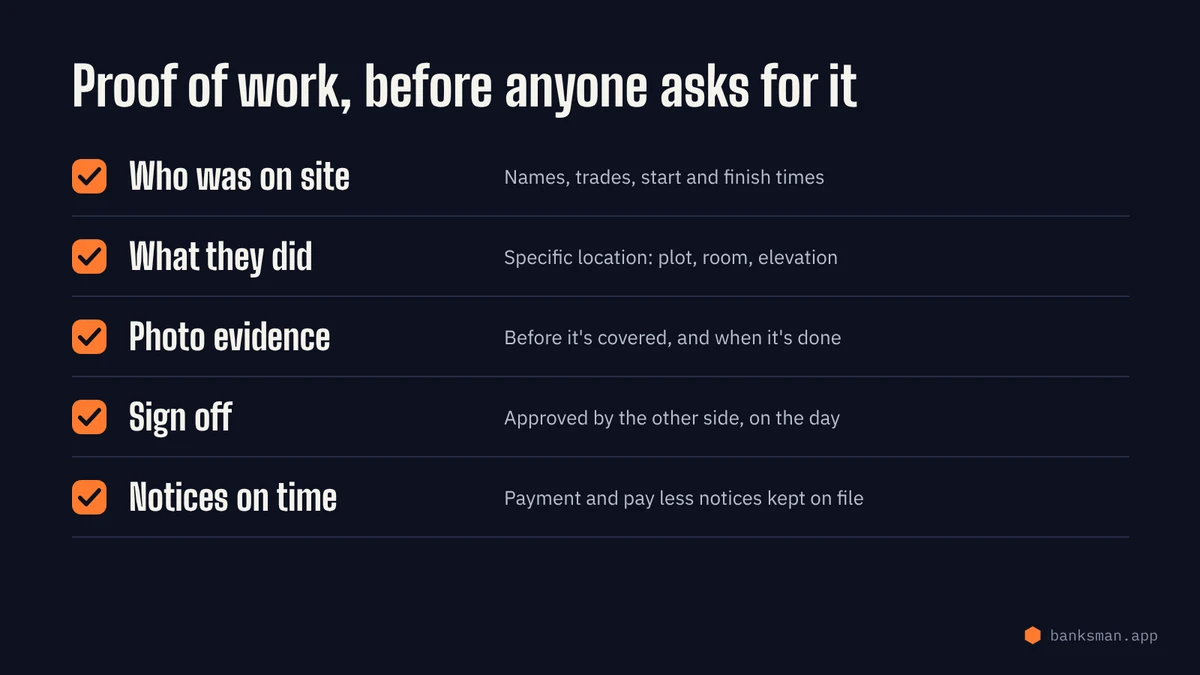
What good proof of work looks like
-
Hours logged on site on the day, by the person who worked them
-
Daywork marked as daywork, separate from priced work
-
Photos tied to the specific task, with a date and time
-
Approval from the main contractor’s side before invoicing
-
Notices sent on time and kept on file
Banksman logs hours and daywork on site, with photo evidence tied to each task and approval from the office before anything is invoiced. Try the live demo, no card required.
FAQ
Can a main contractor refuse to pay because they're unhappy with the work?
They can dispute the amount, but under the Construction Act they generally have to issue a valid pay less notice in time, setting out what they'll pay and why. Without one, the notified sum is usually due.
What if the daywork sheet was never signed?
It's harder to prove, but not impossible. Photos, messages, delivery records and a daily site log from the time can all support your claim. That's why recording the day as it happens matters.
Are "pay when paid" clauses allowed?
Generally no. The Construction Act makes pay when paid clauses ineffective in most construction contracts, except where the paying party upstream is insolvent.
What CIS rate applies to daywork?
The same as any other payment to that subcontractor: 20%, 30% or 0% depending on their CIS status, applied to the labour part only.