
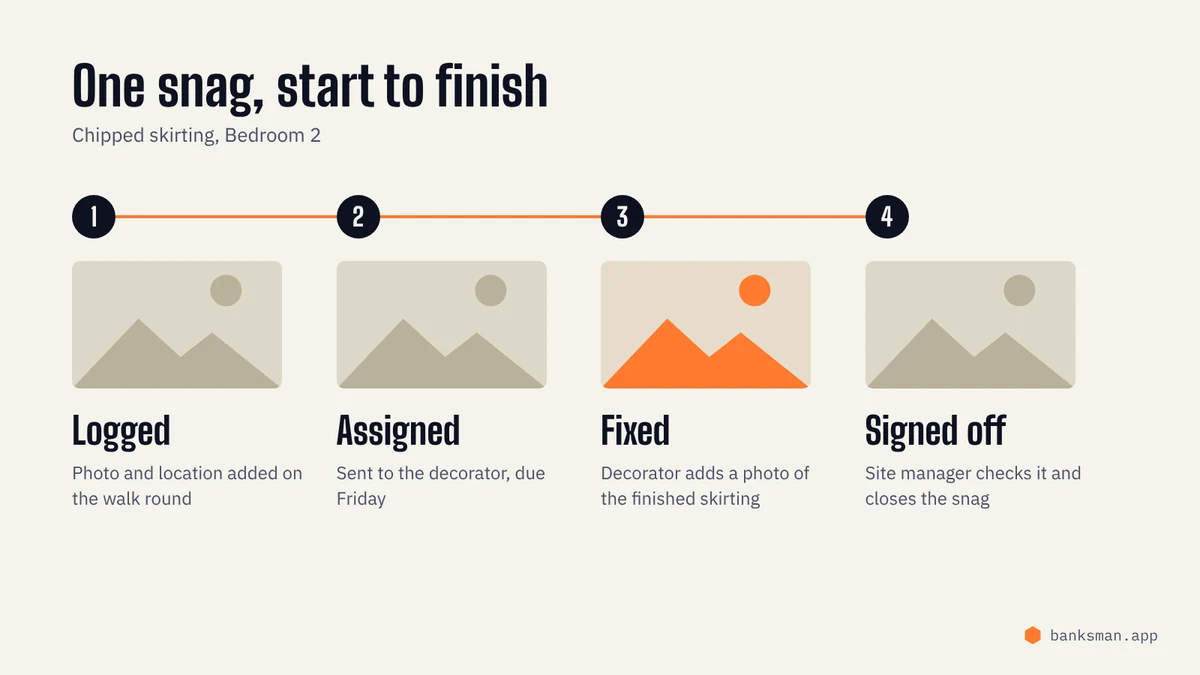
The fastest way to handle snagging is to log each snag once, with a photo and an exact location, assign it to the trade that needs to fix it, and close it with a second photo showing it’s done. Most of the time lost on snagging isn’t fixing things. It’s rewriting lists, chasing the right person and arguing about whether something was already sorted.
Why snagging takes so long
The list gets written three times. Once on a clipboard during the walk round, again in an email to the office, and again as separate messages to each trade.
Locations are vague. “Paint touch up in the bedroom” means nothing when there are four bedrooms. The decorator spends twenty minutes looking for it.
Nobody owns each item. A combined list goes to every subbie, and everyone assumes someone else is dealing with the bits that overlap.
There’s no proof it was fixed. The client says the door still sticks. The joiner says he planed it on Tuesday. There’s no photo either way, or it’s buried in a site WhatsApp group.
Retention waits on it. Half the retention is usually held until the end of the defects period, and it often isn’t released until someone confirms every defect is closed. Every snag left open is money sitting in someone else’s account.
A faster way to run snagging
1. Snag as you go, not just at the end
The cheapest snag is the one caught before the next trade covers it up. Encourage the site manager and trades to log issues during the job, not save them all for a final walk round.
2. Log each snag once, with everything attached
Every snag should have:
-
A photo showing the problem clearly
-
An exact location, such as plot, room, wall or a reference on the drawing
-
A short description of what’s wrong
-
The trade responsible for putting it right
-
A due date
3. Assign it to one person
Each snag goes to the trade who’ll fix it, not to a general list. They see only what’s theirs, and they know when it’s due.
4. Close it with a photo
When it’s fixed, the person who fixed it adds a photo of the finished item. Someone else checks it and signs it off. That second photo ends most arguments before they start.
5. Keep the record after handover
Defects that turn up later, during the defects or rectification period, go in the same place. When the period ends, you can show every item that was raised and closed.
Where the time actually gets saved
| Step | Paper and WhatsApp | One shared snag list |
|, |, |, |
| Writing the list | Written up again for the office and each trade | Logged once on site |
| Finding the snag | Trades hunt for vague locations | Photo and exact location attached |
| Chasing | Ringing round to see what’s done | Status shows what’s open |
| Proving it’s fixed | Someone’s word against someone else’s | Before and after photos |
| Handover | List reconstructed from memory | Record already complete |
Snagging with clients
On domestic jobs especially, how you handle snags shapes how the client remembers the whole project. A few things help:
-
Agree a single snag walk round with the client near the end, rather than a stream of messages
-
Give them a clear list of what’s been logged and when each item will be done
-
Send before and after photos as items are closed
-
Agree in writing when the job is complete, so the defects period has a clear start date
In Banksman, a snag is just a task: logged with a photo, assigned to a trade, and marked done with a photo as proof. Try the live demo, no card required.
FAQ
What's the difference between snagging and defects?
In everyday use, snags are minor items found around completion, like paint touch ups, a sticking door or a missing cover plate. Defects is a broader term, often used for problems that show up during the defects or rectification period after completion. You can manage both the same way.
How long is a typical defects period?
It depends on the contract, but six to twelve months after practical completion is common in UK construction.
Who should do the snagging walk round?
Usually the site manager, and ideally the client too near the end. On larger jobs a clerk of works or the architect may also inspect.
Do I need a special snagging app?
Not necessarily. What you need is somewhere to log each snag with a photo and location, assign it to someone, and close it with proof. Any tool that does that reliably will save time over paper and group chats.